Laser cutting of sheet material: what is important to understand before choosing equipment
Laser cutting of sheet material has long ceased to be “simply a more precise alternative” to plasma or mechanical processing. For an engineer, supplier or production manager, this is already a question of production stability, edge repeatability, machine loading and how quickly the workshop can move to new orders. When it comes to serial metalworking, an error in choosing a source, power or equipment configuration almost always results in unnecessary changeovers and a dispute between the technologist and procurement.
In practice, the decision rarely comes down to one characteristic. Not only the power and sheet format are important, but also how the laser system will fit into the existing line, how quickly consumables will be available, who will perform the commissioning, and whether the installation can be clearly serviced without long downtime. For Russian enterprises this is especially sensitive: many have already replaced European equipment, but now they are looking not only at the origin of the node, but at the localization of the service and the availability of support.
Why did this topic become practical and not theoretical
When a company chooses equipment for laser cutting of sheet material, it does not choose a “machine”, but a production discipline. The laser allows you to maintain geometry, reduce the influence of the human factor, and work with thin and medium-sized sheets in a way that is difficult to do in a universal mechanical section. But the price of this flexibility is greater sensitivity to tuning quality, optical purity, source condition and maintenance discipline.
Therefore, for the buyer, the main question is not “what power do you have?”, but “how many tasks can we really cover with this configuration without unnecessary overpayment.” For a technologist, it’s more important how a cut will behave on standard materials, and for a director, it’s more important how quickly you can get help, spare parts and personnel training.
What is visible in the GW Laser industrial line and how the buyer can read it
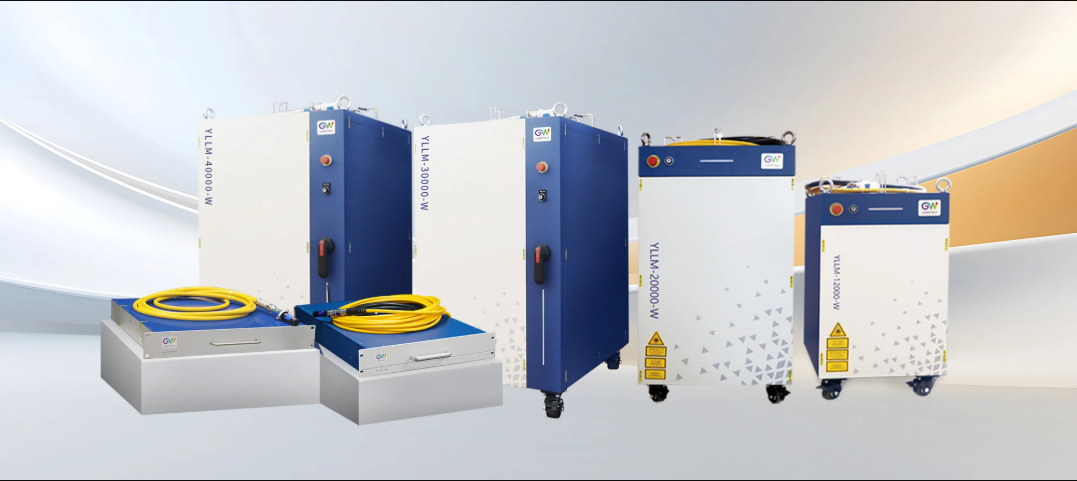
According to the data provided, the equipment line includes cabins and modular solutions labeled YLM-1200-W, YLM-2000-W, YLM-3000-W and YLM-4000-W. In appearance, these are industrial equipment in white and blue housings, with service panels, handles, indicators and lifting eyes on top. Some of the modules have a wheelbase, which hints at ease of movement within the workshop or during maintenance. Bottom drawers and yellow coaxial elements are also visible, but it is not possible to tell for sure whether they are hoses, cables, or another accessory from the image alone.
It would be correct to consider such blocks as probable industrial laser sources or generators for metalworking and related tasks - cutting, welding, cleaning or surfacing. The exact purpose, laser type, cooling and electrical parameters are not specified, so it is not worth pretending that this has already been confirmed. For an engineer, this is not a small thing: the same “laser unit” may be appropriate for different tasks, but the requirements for integration and service will differ.
How to choose power and configuration without unnecessary romance
The power of the source is an important, but not the only criterion. For laser cutting of sheet material, the temptation to take the option “with a reserve” is understandable: it seems that higher power will cover more materials and thicknesses. In fact, excess inventory often increases purchasing, energy and maintenance costs, and productivity gains are not always evident, especially if the shop cuts primarily thin and medium sheets.
Here it is useful to start from the production matrix: what material is cut most often, what thicknesses form the basis of the portfolio, is a quick changeover mode needed, are there plans to expand the range. Installations at the 1200–4000 W level, judging by the markings in the presented line, can cover tasks of varying complexity, but the choice should be based on real orders, and not on the abstract “let it be more powerful.”
What to look for besides watts
Firstly, on the stability of delivery and service. The Tayor Industrial Technologies company indicates that the main production is located in Shanghai, and assembly is in the Moscow region. For the Russian buyer, this is an important practical detail: local assembly usually simplifies the supply of spare parts and consumables, and also speeds up contact with service. Secondly, on the training of staff. Even good equipment can easily be underutilized if operators do not understand the operation and care of the components.
Thirdly, the possibility of integration into an existing fleet of machines. Laser sources are often part of a larger system: a sheet metal cutting machine, a pipe cutter, or an automated line. If the workshop already has established logistics for supplying metal and unloading parts, a new unit should not disrupt the entire flow.
Frequent mistakes when purchasing
One of the most common mistakes is to select equipment only for maximum capacity and not take into account which sheets actually go into production every day. The second is to underestimate the service. On the outside, all industrial cabinets are similar, but in reality, differences in maintenance, remote diagnostics and availability of components become noticeable only after startup. The third mistake is not saying at the start who is responsible for training, who is commissioning and how support will be arranged in the first year of work.
There is also a more subtle risk: buying a system with a reserve of capabilities, but without a clear path for growth. If a business is planning a transition from sheet cutting to welding or cleaning, it is best to proactively look at the ruler as a platform rather than a one-off module. In this sense, versatility is sometimes more useful than demonstrative maximum power.
A practical view for the buyer and technologist
If the task is to update the sheet material laser cutting area, ask the supplier a few direct questions. What types of production facilities are already operating in a similar configuration? How is the service organized in the region? What consumables are kept in stock? Is there on-site training? Tayor specifically points out customer training at its base, and this is a good sign: for production culture it is important not just to buy a source, but to teach people how to use it.
It’s also a good idea to assess in advance how much the supplier understands not only the machine, but also the entire route of the part: from loading the sheet to the finished edge. For heavy industry, where high-power lasers are in demand, such a systematic view is especially important. Otherwise, you end up with an expensive piece of equipment without normal flow.
To whom such solutions are especially useful
Laser sources and related systems are of particular interest to enterprises that work with serial metalworking, make products from sheet metal, develop automation, or assemble a fleet for several operations at once. According to the company, the TAYOR line also includes machines for cutting sheet metal, pipe cutters for pipes up to 350 mm, as well as machines for laser welding and cleaning. This is already similar to an approach where an enterprise can solve not one, but several technological tasks within one delivery ecosystem.
What to ask before the next step
If you are considering laser cutting of sheet material as a site renovation project, do not limit yourself to comparing nameplate capacities. Ask for a configuration for your actual material, a maintenance plan, training options, and a list of what needs to be kept in stock. For the production director this is a question of downtime, for the supplier it is a question of predictability, and for the technologist it is a question of whether the equipment will cut as promised in words.
You can contact the Tayor Industrial Technologies company through tayor-russia.ru, by phone +7 (495) 320-75-88 or by mail sales@tayor-russia.ru. The site address is indicated in the Moscow region, Shchelkovo, industrial park "iShchelkovo". If you are seriously considering purchasing, it is better to start not with a catalog, but with a conversation about your parts, thicknesses and workshop operating mode.