


The automated CNC center with robotic loading combines high-precision machining, automatic workpiece feeding, process control and a safe closed design in a single production system. The equipment is suitable for mass production of metal parts when the customer needs to reduce manual operations, increase repeatability and ensure stable productivity.
Such a CNC machine with a robot for metal can be adapted to the dimensions of the parts, the material of the workpieces, technological operations, the required productivity and the current standards of the enterprise. Integration of fixtures, measuring systems, automatic tool changing, chip removal and digital production control is available.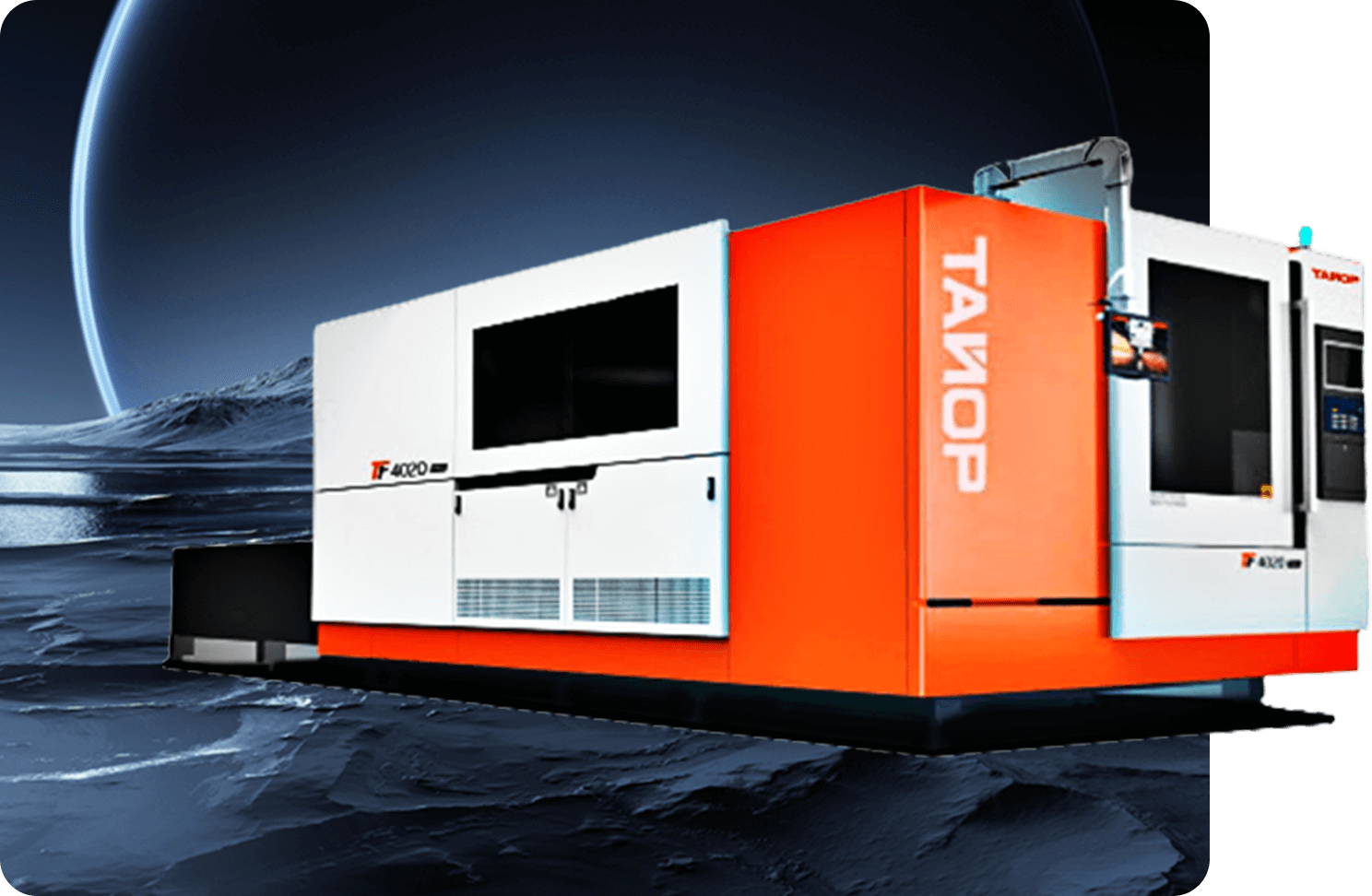
Automated CNC center for serial processing of parts
Our automated loading CNC center is designed for businesses that require consistent part processing with minimal operator intervention. The complex combines a processing machine, a robotic loading and unloading system, a safety fence, a control system and auxiliary production modules.
Unlike a separate machine, such a system performs several stages of the production cycle automatically. The workpiece is fed into the working area, fixed in the fixture, processed according to a given program, checked and moved to the unloading area. This reduces downtime between cycles and ensures more predictable product quality.
As a manufacturer of automated CNC centers, we can tailor equipment configurations to fit part drawings, annual production volume, accuracy requirements, available workshop space and existing production infrastructure.
Main features of the equipment
Robotic loading and unloading
The integrated robotic module automatically moves workpieces between the storage, work fixture and finished product area. This reduces reliance on manual labor and ensures consistent production cycle times.
The system can be expanded with:
- magazine or storage unit for workpieces;
- conveyor feed;
- part position recognition system;
- automatic opening of the machine door;
- sensors for the presence and correct installation of the workpiece;
- module for marking or sorting finished parts.
Completely enclosed work area
A robust, enclosed structure separates the processing process from the surrounding production area. It helps keep chips and coolant inside equipment, reduces contamination in the work area and improves worker safety.
Safety doors can be equipped with interlocks that prevent access to the machining area while the spindle is running or the robot is moving.
Automatic tool change
The tool magazine allows you to perform several operations without manually stopping the equipment. One production cycle may include milling, drilling, boring, threading, chamfering and other operations.
The number of positions in the magazine and the type of holders are selected taking into account the technological map of the part.
Consistent accuracy and repeatability
The rigid structure of the machine, precise guides, servo drives and a reliable locking system help maintain stable dimensions of parts during mass production.
To improve quality control, a CNC machine with a metal robot can be equipped with a measuring probe, a tool monitoring system and sensors for correct clamping of the workpiece.
Centralized management
The operator can control machining, automatic loading, tool status and alarms through a single control system. The panel displays the current program, cycle time, equipment status and diagnostic messages.
Integration with MES, ERP or the customer’s internal production management system is possible.
Key benefits for B2B buyers
| Opportunity | Practical advantage |
|---|---|
| Robotic loading | Reduces repetitive manual tasks |
| Continuous production cycle | Increases equipment utilization |
| Automatic tool change | Allows you to perform multiple operations in one installation |
| Closed design | Improves the safety and cleanliness of the work area |
| Workpiece availability control | Reduces the risk of incorrect part installation |
| Automatic chip removal | Reduces equipment maintenance time |
| Digital monitoring | Simplies monitoring of machine performance and condition |
| Individual adaptations | Allows processing of special or complex parts |
| Modular configuration | Simplies production line expansion |
| OEM design | Adapts the system to the requirements of a specific production |
Reducing production costs
Automated CNC center with loading helps reduce manual operations. One operator can control multiple automated machines or production cells, instead of constantly loading each part into a separate machine.
The economic effect is especially noticeable in serial and mass production, where repetitive actions take up a significant portion of the cycle time.
Improving quality stability
Manual loading may result in differences in workpiece position, clamping force and time between cycles. The robotic system performs operations according to a single algorithm, increasing the repeatability of the production process.
Additional measuring systems can monitor workpiece position, tool wear and critical part dimensions.
Increasing battery life
With sufficient workpiece storage, the equipment can continue to operate for a long time without the constant presence of an operator. This makes the system suitable for evening shifts, night production and plants with a limited number of qualified personnel.
Areas of application
A CNC machine with a metal robot can be used to process a variety of serial components.
| Industry | Typical details |
|---|---|
| Automotive industry | Housings, brackets, hubs, connecting components |
| Valve production | Valve bodies, flanges, covers and seating surfaces |
| Pumping equipment | Pump housings, operating elements and connecting parts |
| Plumbing fittings | Faucer bodies, fittings and brass components |
| Industrial equipment | Base plates, housings, holders and mounting parts |
| Electromechanical products | Motor housings, gearboxes and drive mechanisms |
| Aerospace components | High precision aluminum and special parts |
| General mechanical engineering | Steel, cast iron, aluminum and brass blanks |
Actual material processing capability depends on the spindle configuration, cutting tool, cooling system and selected technology.
Technical specifications
The parameters below are configurable. Before posting on the site, it is recommended to replace them with actual data for a specific model.
| Parameter | Available configuration |
|---|---|
| Equipment type | Fully enclosed automated CNC machining center |
| Automation system | Robotic loading and unloading |
| Basic operations | Milling, drilling, boring, threading |
| Number of controlled axes | Selected according to processing technology |
| CNC system | FANUC, Siemens, Mitsubishi or equivalent |
| Spindle type | High-speed or high-torque |
| Spindle speed | Selected according to material and technological process |
| Tool magazine | Disc or chain, capacity on request |
| Fixation system | Hydraulic, pneumatic or servo-driven device |
| Blank materials | Aluminium, steel, cast iron, brass and other processed metals |
| Cooling system | External or internal coolant supply |
| Chip removal | Automatic screw or chain conveyor |
| Tool control | Breakage sensor and tool measurement optional |
| Part control | Measuring probe or visual system optional |
| Loading blanks | Storage, conveyor, pallet or individual store |
| Security system | Closed fence, interlocks, alarm and emergency stop |
| Connecting to production | MES, ERP, barcoding and remote monitoring optional |
| Electrical standard | Adjustable to the country of operation |
| Line layout | Developed for the area and logistics of the workshop |
Custom configurations available
Specialized clamping fixtures
Hydraulic, pneumatic or mechanical attachments can be developed for non-standard parts. The design takes into account reference points, tool access, clamping force and part deformation requirements.
Quality control within the production cycle
The probe can check the workpiece position and individual dimensions directly inside the machine. If a deviation is detected, the system can stop the cycle, adjust the tool, or send the part to a separate zone.
Automatic product identification
For mixed production, it is possible to install a barcode, QR code or RFID reader. The system detects the type of part and automatically selects the appropriate machining program.
Additional production modules
The automated complex can be supplemented with equipment for:
- cleaning finished parts;
- deburring;
- markings;
- measurements;
- sorting;
- appearance control;
- accumulation of finished products;
- transfer of parts to the next operation.
Design of an automated CNC solution
As a manufacturer of automated CNC centers, we begin the project by analyzing the customer's actual production process. To prepare a proposal, it is advisable to provide:
- 2D and 3D drawings of the part;
- material and condition of the workpiece;
- current technological process;
- required tolerances and roughness;
- planned production volume;
- target cycle time;
- quality control requirements;
- plan or dimensions of the production site;
- local electrical standards;
- requirements for integration with an existing line.
На основании этих данных подбираются модель станка, тип робота, система подачи, приспособления, режущий инструмент и программное обеспечение.
Контроль качества и приёмка оборудования
Перед отгрузкой автоматизированная система может пройти заводские приёмочные испытания FAT. Во время испытаний проверяются работа станка, роботизированная загрузка, зажим детали, смена инструмента, безопасность и стабильность производственного цикла.
По согласованию с заказчиком может быть выполнена тестовая обработка предоставленных заготовок. Результаты проверяются с использованием согласованных измерительных приборов.
Комплект поставки может включать:
- техническую документацию;
- электрические схемы;
- руководства по эксплуатации;
- программы обработки;
- перечень запасных частей;
- инструкции по обслуживанию;
- обучение операторов;
- удалённую техническую поддержку;
- помощь при установке и запуске.
Часто задаваемые вопросы
Какие детали может обрабатывать автоматизированный ЧПУ-центр?
Оборудование подходит для обработки корпусных, фланцевых, призматических и других серийных металлических деталей. Конкретные возможности зависят от рабочей зоны, числа осей, шпинделя, приспособления и выбранного режущего инструмента.
Можно ли настроить оборудование под одну конкретную деталь?
Да. Конфигурация может быть разработана под определённую деталь или семейство похожих деталей. Производитель автоматизированных ЧПУ-центров может спроектировать приспособление, роботизированный захват, накопитель и программу обработки под требования заказчика.
Какие материалы можно обрабатывать?
В зависимости от конфигурации станка система может обрабатывать алюминий, углеродистую и нержавеющую сталь, чугун, латунь и другие металлические материалы.
Как робот определяет правильное положение заготовки?
Для этого используются механические направляющие, датчики присутствия, системы позиционирования и, при необходимости, машинное зрение. После загрузки система также может проверять правильность фиксации детали.
Можно ли подключить оборудование к существующей производственной линии?
Да. ЧПУ-станок с роботом для металла может быть интегрирован с конвейерами, измерительными станциями, моечными установками, системами маркировки и внутренним производственным программным обеспечением.
Как подтверждается точность оборудования?
Точность проверяется во время заводских испытаний и тестовой обработки. Для деталей со специальными требованиями согласовываются методы измерения, контрольные точки и критерии приёмки.
Какие данные нужны для расчёта стоимости?
Для точного расчёта необходимо предоставить чертежи детали, материал, размеры заготовки, требуемую производительность, допуски, список операций и требования к автоматизации.
Заключение
Автоматизированный ЧПУ-центр с загрузкой представляет собой комплексное решение для предприятий, которым необходимо увеличить производительность, сократить ручные операции и обеспечить стабильное качество серийных деталей. Интеграция станка, роботизированной загрузки, автоматической смены инструмента и цифрового контроля создаёт единый управляемый производственный цикл.
Отправьте чертежи деталей, материал заготовки, требуемый объём выпуска и планируемое время цикла. На основе этой информации мы подготовим конфигурацию оборудования, схему автоматизации и коммерческое предложение для вашего производственного проекта.